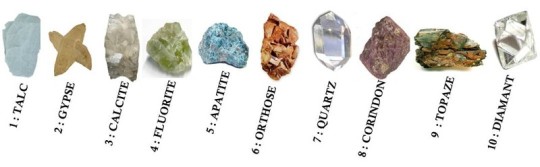
Mohs Scale
Mohs scale is an ordinal, non-linear, and non-logarithmic scale based on the principle of comparing two minerals, that is, the ability of one to scratch another whose hardness is already known.
Invented by Friedrich Mohs in 1812, a German mineralogist, this scale measures mineral hardness on 10 levels.
Mohs Scale: Hardness Evaluation Table
| Level | Reference mineral | Gemstone examples |
|---|---|---|
| 10 | Diamond | Diamond |
| 9 | Corundum | Ruby, Sapphire |
| 8 | Topaz | Topaz, Emerald (Beryl) |
| 7 | Quartz | Amethyst, Citrine, Quartz |
| 6 | Orthoclase (Feldspar) | Moonstone, Labradorite |
| 5 | Apatite | Apatite, Turquoise |
| 4 | Fluorite | Fluorite |
| 3 | Calcite | Calcite, Pearl |
| 2 | Gypsum | Gypsum |
| 1 | Talc | Talc |
Principle of measurement
The scale works by comparison: a mineral can scratch all those below it on the scale, but will be scratched by those above it. For example, quartz (7) can scratch glass (5.5) but will be scratched by topaz (8).
Importance in gemmology
Knowledge of a gemstone's hardness is essential for:
- Identifying precious stones
- Determining handling precautions
- Advising on appropriate use (jewelry worn daily vs special occasions)
- Choosing suitable cleaning methods